


Beyond the Battlefield, hosted by I Survived author Lauren Tarshsis, is available for streaming February 7, 2018.
Back to Teacher View
Student View
GARY HANNA
Blood, Smoke, and Freedom
Students will read about the first major battle of the Revolutionary War and its causes. They will identify text evidence and build vocabulary as they read about a 15-year-old boy who fought during all eight years of the war.

By Lauren Tarshis
From the March / April 2018 Issue
Learning Objective: Students will read about the first major battle of the Revolutionary War and its causes. They will identify text evidence and build vocabulary as they read about a 15-year-old boy who fought during all eight years of the war.
Lexiles: Starter, 350L, 570L, 780L
Guided Reading Level: O
DRA Level: 34
Featured Skill:
Text Evidence,
Standards
video
(2)
video
(2)
Audio
()
Activities
(7)
Reading Kit
Skills Activities
Quizzes
(2)
Quizzes
(2)
Answer Key
(2)
Answer Key
(2)
video
(2)
video
(2)
Audio
()
Activities
(7)
Download All Quizzes and Activities
Reading Kit
Skills Activities
Quizzes
(2)
Quizzes
(2)
Answer Key
(2)
Answer Key
(2)
 Can't Miss Teaching Extras
A Virtual Field Trip to the Museum of the American Revolution
Historical Reenactments
When you watch our Video Read Aloud, point out that the war footage comes from war reenactments. Explain that reenactors are people so fascinated by a certain time in history, they’ll put lots of effort into recreating it. They’ll wear the clothing of that time (or the closest they can get to it), they’ll eat the food from that time, and even fight the battles of that time, with old-fashioned weapons. And it’s not just for adults—there are children’s programs where kids learn and practice games and chores of the Revolutionary era!
Further Reading
Two books will keep the learning going: George vs. George: The American Revolution as Seen From Both Sides is filled with colorful, detailed illustrations and authentic quotes. You Wouldn’t Want to be an American Colonist!, with its humorous take on the era, is praised for being ideal for reluctant readers.
Life in Colonial America
Don’t miss our Time Machine video about what life was like in colonial America! After reading the story and watching the video, ask students: What was it like living in the time of the Revolutionary War? Would you want to live back then? Why or why not? These questions can also serve as writing prompts.
Child Soldiers
Students might be surprised to learn that Joseph wasn’t the youngest of the American soldiers during the Revolutionary War. Kids as young as 12 served!
More About the Article
Content-Area Connections
Social Studies: U.S. history, world history, geography
Key Skills
text evidence, text features, sensory details, figurative language, synthesizing, problem and solution, vocabulary
Step-by-Step Lesson Plan
1. PREPARING TO READ
Watch a Video/Preview Text Features (25 minutes)
- This story is accompanied by a Video Read-Aloud narrated by author Lauren Tarshis. Riveting photos and footage help students visualize what life was like during the Revolutionary War. The video can be used as a “first read.”
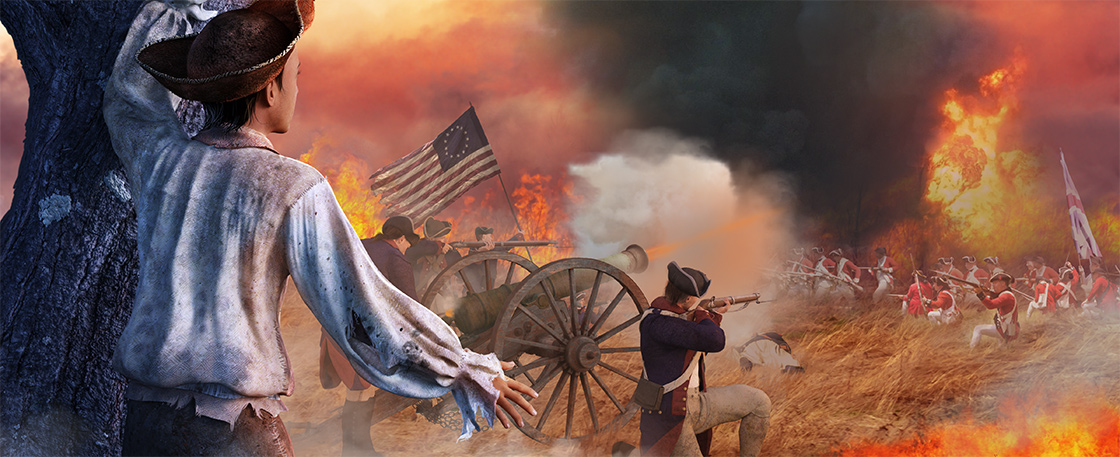
- Look at pages 4 and 5 with the class. Direct students’ attention to the title, subhead, and illustration. Ask: What do you notice about the colors of the title? Point out Joseph on the first page. Ask: What do you think he was feeling in this scene?
- Turn to the map on pages 6 and 7. Explain that these were the original 13 colonies, and point out that Joseph came from Connecticut, trained in New York City, and fought in Brooklyn. He later moved to Maine. Point out Europe and England too.
- Look at the illustrations of “The Two Georges” on pages 8 and 9. Ask: Based on the portraits and captions, how were the men similar? In what ways were they different?
Introduce Domain-Specific Vocabulary (15 minutes)
- We have highlighted in bold eight words that may be challenging and defined them on the page. Preview these words by projecting or distributing our vocabulary activity and completing it as a class. You may also play our Vocabulary Slideshow.
- Highlighted words: doomed, surrender, wilderness, slaves, smoldered, bustling, forts, urgent
Set a Purpose for Reading (5 minutes)
- Both the Think and Read and Think and Write boxes on pages 5 and 9 support the story’s featured skill, text evidence. Ask students to look for the details the author shares as she describes the story’s events.
2. CLOSE READING
Reading and Unpacking the Text
- First read: Read the story as a class. Use the Pause and Think questions at the end of each section to check comprehension.
- Second read: Distribute Close-Reading and Critical-Thinking Questions to the class. Preview them together. Ask students to read the article again and answer the questions as a class or in small groups.
- Don’t miss our first-ever Virtual Field Trip, where Lauren Tarshis takes your students on a tour of the Museum of the American Revolution in Philadelphia. (See details on page 1!)
Close-Reading Questions (30 minutes)
- Read the first section. What details help you see, feel, and hear what it was like to be Joseph during that first big battle of the war? (sensory details) Joseph was lying on the ground. There were loud explosions that made the ground shake. The air was filled with smoke. All around him were the cries of men who had been injured.
- In “A New World,” which details show that life was hard for some people in the colonies? (text evidence) Life was hard for Native Americans, many of whom died. They died from diseases that had been brought by people who came from Europe. They were killed in fights over their land. They starved to death after they had to leave their homeland. Meanwhile, African people were brought to America against their will and forced to become slaves.
- The author says in “A New World” that America’s anger toward England “smoldered like a fire.” What does she mean? Why were Americans angry? (figurative language) She means that Americans’ feelings burned slowly, getting bigger and bigger and out of control, as a fire does. They were angry because they had to follow England’s rules.
- In “Getting Ready to Fight,” what main challenges did George Washington and the American army face? (synthesizing) Washington had not led an army before, and most of the soldiers didn’t know how to fight in a war. They had to learn to march, shoot, and become strong fighters.
- In “Secret Escape,” why did Washington need boats in Brooklyn right away? (problem and solution) Washington wanted to sneak his soldiers out of Brooklyn before the British army arrived to attack the Americans. He asked for boats so that his soldiers could sail back across the river to New York City.
- Read the box “If You Had Lived in 1776 . . .” on page 9. How does it help you understand that life was different during the time of the American Revolution than it is today? (text evidence) The photos and captions provide four facts that show life during that time is nothing like it is today. For instance, children liked to eat a pie baked with eel, a slimy snakelike creature. Kids went to a one-room schoolhouse, and one teacher taught all of the students. Shoes were painful to wear, and because toilet paper didn’t exist, people used corn cobs to stay clean!
Critical-Thinking Question (10 minutes)
- What are some of the details that tell you that being a soldier was very important to Joseph? (text evidence) Answers will vary but may include: Joseph begged his family to let him become a soldier; he never complained about training, even when the conditions were difficult; and even though he always remembered how frightening it was to be a soldier, Joseph was proud that he’d helped America win its freedom.
3. SKILL BUILDING
- Distribute our Text Evidence activity sheet. Have students work in small groups to complete it.
- Discuss the task in the Think and Write box on page 9. Remind students to include at least five details.
 Differentiate and Customize
For Small Groups
As they read the story aloud, have students answer each Pause and Think question. They should mark the text evidence that supports the answer with sticky notes. Then have the groups share their answers and evidence with the class.
For ELL Students
Share the Starter version of the story with your students, and work up to the Lower-Lexile version. Be sure to play the audio version of the Lower-Lexile story too. The Vocabulary Slideshow will also help students comprehend the story.
For Struggling Readers
Read the Lower-Lexile version of the story with your students. Ask them to come up with a list of the five most interesting or surprising facts from the story. They can then share their favorite fact with the group.
For Advanced Readers
After reading the article, students can explore the role that African-Americans played in the Revolutionary War. A book like Black Heroes of the American Revolution by Burke Davis will help with their research.
For On Level Readers
Pretend you’re Joseph in 1776. Write a journal entry explaining how hard it is to be an American soldier. Include at least five details from the story. Send it to “War Contest” by May 15.
Text-to-Speech